Saturday, October 24, 2026

The Martians next steps

Next steps for "The Martians" project.

World creation

Gather visual material about the world the story's characters live in.
  • Buildings
  • Street Scenes
  • Clothing
  • Food

Sets

  • Make simple white card models of buildings
  • Add miniature people and props
  • Take photos

Samples

  • Fabric samples
  • Natural lighting samples from the region at different times of year
  • Street culture and mannerisms

Script sources

  • Newspaper articles of the time
  • Recorded lectures
  • Published scientific articles
  • Letters

Website

  • Project website
  • Use film studio workspace from Ajabbi

Tuesday, October 13, 2026

The Martians

This project is well underway. We'll post more updates as we make progress.

Redworks will be our initial development vehicle once we quickly sort out a few minor legal and tax issues.

The project will be self-funded by the being-established Ajabbi Foundation. More information about the maths and science will be made available at On a Sandy Beach.

The Martians is a working title for a publishing and associated screen project under development. It is about how a group of Hungarian Jews revolutionised mathematics and physics between the French Revolution and WW2. After the revolutions of 1848, the slow decay of the Austro-Hungarian Empire led to WWI, then to the Russian Revolution, the Stalinist counter-revolution, anti-semitism and the rise of Hitler. The project ends with the start of World War II.

The sudden explosion of genius from late 19th and early 20th-century Budapest is one of the greatest intellectual mysteries of modern history. Historians generally agree that it wasn't a coincidence, but rather the result of a highly specific "perfect storm" of political, educational, and cultural factors unique to the Austro-Hungarian Empire.

Here are the primary reasons why this specific environment bred such extraordinary minds:

1. The Legendary High Schools (Gimnáziums)

The Hungarian secondary education system at the time is widely considered one of the best in human history. Following reforms in the late 19th century, the state established gimnáziums (high schools) modelled after the rigorous German classical system, but with a heavier emphasis on mathematics and hard sciences.

  • Elite Teachers: Because university positions were limited, many world-class scientists and mathematicians taught at the high school level.
  • The "Fasori" Phenomenon: Schools like the Fasori Evangélikus Gimnázium produced John von Neumann and Eugene Wigner in the exact same generation.

2. A Hyper-Competitive Culture of Math

Hungary turned mathematics into a highly prestigious, nationwide competitive sport.

  • The KöMaL Journal: Founded in 1894, this monthly high school mathematics and physics journal published incredibly difficult, creative problems. Students from all over the country mailed in their solutions, which were graded and published. This created a national, collaborative network of young geniuses who pushed each other to their absolute limits before ever reaching university.
  • The Kürschák Competition: This annual, blind-graded mathematics competition identified the country's top talent, turning young mathematicians into national celebrities within academic circles.

3. Jewish Emancipation and the "Golden Age" of Budapest

Following the Austro-Hungarian Compromise of 1867, Jews in the empire were granted full civil rights. This triggered a massive wave of urbanisation, and Budapest quickly grew into a booming, wealthy metropolis.

  • The New Middle Class: Barred from traditional aristocratic roles like landownership or politics, the newly emancipated Jewish population poured their wealth and energy into education, medicine, science, and industry. Most of the "Martians" came from this highly driven, affluent Budapest Jewish bourgeoisie, where intellectual achievement was viewed as the ultimate status symbol.

4. The "Budapest Coffee House" Culture

Much like Vienna, Budapest developed a vibrant coffee house culture. Intellectuals, writers, artists, and scientists did not lock themselves in laboratories; they spent their afternoons in cafes like the New York Café or Café Centrál. Ideas from physics, psychology, literature, and economics were fiercely debated across disciplines, fostering lateral thinking, intense debate, and intellectual agility.

5. A State of Creative Anxiety

The "Martians" grew up in a world of profound instability. They witnessed the collapse of the Austro-Hungarian Empire, a communist revolution, a Stalinist counter-revolution, hyperinflation, and the rapid rise of virulent anti-Semitism and Fascism.

  • This created what Eugene Wigner called a "feeling of extreme insecurity" and an awareness that everything they owned could be taken away—except what was inside their minds.
  • This background forced them to be adaptable, highly driven, and comfortable with chaos, traits that proved invaluable when they later had to solve unprecedented problems in wartime America.

"The Martians" (Hungarian: A marslakók) was a nickname for a group of exceptionally brilliant Hungarian physicists and mathematicians who emigrated to the United States in the early 20th century. Most were secular Jewish refugees fleeing Nazi expansion and rising anti-Semitism in Europe.

The name originated as a joke among colleagues like Enrico Fermi and Leo Szilárd. When discussing the Fermi Paradox—asking why there is no evidence of intelligent extraterrestrial life—Szilárd quipped that aliens were already here, but they simply disguised themselves as Hungarians. The moniker stuck because these scientists possessed seemingly superhuman intellects, all grew up within walking distance of each other in Budapest, and spoke English with a thick, matching accent.

Core Members of "The Martians"

While the wider group included up to 23 thinkers, the core group of five distinct "Martians" reshaped modern physics, defence, and computing:

  • John von Neumann (1903–1957): Widely considered one of the greatest mathematicians of the 20th century.
  • Leo Szilárd (1898–1964): The visionary physicist who conceived the nuclear chain reaction.
  • Edward Teller (1908–2003): Theoretical physicist known historically as the "father of the hydrogen bomb".
  • Eugene Wigner (1902–1995): Theoretical physicist who won the Nobel Prize in Physics in 1963.
  • Theodore von Kármán (1881–1963): A pioneer in aerodynamics and mathematics.
Others included:
  • Denis Gabor: A physicist who won the 1971 Nobel Prize in Physics for inventing holography.
  • John G. Kemeny: A mathematician and computer scientist who co-developed the BASIC programming language.
  • George Pólya: Mathematician
  • Paul Erdős: One of the most prolific mathematicians in human history, known for his eccentric lifestyle and work in combinatorics and number theory.
  • Cornelius Lanczos:
  • Egon Orowan:
  • Franz Alexander:
  • George de Hevesy:
  • George Olah:
  • John Harsanyi:
  • John Polanyi:
  • Paul Halmos:
  • Paul Neményi:
  • Peter Carl Goldmark:
  • Peter Lax:
  • Valentine Telegdi:

Impact on Science and Mathematics

The Martians did not just contribute to their fields; they laid the bedrock for the technology, national security, and computational infrastructure of the modern world.

  • The Von Neumann Architecture: John von Neumann designed the framework for modern digital computers. He pioneered the system in which data and program instructions are stored in the same memory space—a fundamental structure that nearly all desktop computers, smartphones, and servers still use.
  • Cellular Automata: Von Neumann created the concept of cellular automata, modelling self-reproducing systems on computer screens before the biological role of DNA was even fully understood.
  • The Nuclear Chain Reaction: In 1933, Leo Szilárd conceived the idea of a neutron-driven nuclear chain reaction and patented it.
  • The Manhattan Project: Recognising the threat of Nazi Germany, Szilárd drafted the famous Einstein–Szilárd letter to President Franklin D. Roosevelt, which sparked the creation of the Manhattan Project. Von Neumann, Wigner, and Teller all performed core calculations that made the atomic bomb a reality.
  • Thermonuclear Weapons: Post-WWII, Edward Teller drove the physics and design behind the first hydrogen bomb, fundamentally changing Cold War geopolitics.
  • Aviation & Space Flight: Theodore von Kármán provided the mathematical and scientific foundation for modern aerodynamics. He discovered the Kármán vortex street (fluid dynamics) and helped establish the U.S. Air Force’s research wing.
  • JPL Founding: Von Kármán later co-founded NASA's legendary Jet Propulsion Laboratory (JPL).
  • Game Theory: John von Neumann co-created mathematical Game Theory, publishing Theory of Games and Economic Behaviour. This framework mathematically analyses strategy, risk, and decision-making, transforming modern economics, evolutionary biology, and military strategy.
  • Quantum Mechanics: Eugene Wigner introduced Group Theory into quantum mechanics. His work on the symmetries of atomic nuclei earned him a Nobel Prize.
  • Heuristics and Education: George Pólya wrote How to Solve It, a foundational text that systematically defined how to approach and teach mathematical problem-solving.

Sunday, May 31, 2026

Riven: Behind the scenes

I got to help on Riven, a 2020 short film directed by Matt Inns. The job was making a large oak tree. A full-scale trunk for on-location use and a matching scale model for physical effects. Here is a video about the making of Riven.

Behind the scenes

The film

Sunday, January 4, 2026

Mike Peters’ career journey: Shedding Light on disability in the workforce

This is a copy of an article published on February 19 2025, by Toitū te Waiora, which was disestablished on December 31, 2025. 

"Toitū te Waiora was one of six Workforce Development Councils (WDCs), dedicated to improving workforce development in Aotearoa New Zealand. Our mission is to shape our workforce for the present and future by working with industry, Māori communities, and education providers."

Mike Peters’ career journey: Shedding Light on disability in the Workforce

Mike lives in Invercargill with his wife Tracy. A heavy engineering welder by trade, Mike was self-taught, loving his work creating large structures. Work, and his adventure sports, were a huge part of Mikes identity until his late 30’s, when a sudden decline in his health led to a diagnosis of Ehlers-Danlos Syndrome (EDS). By 40, he was medically retired, giving up his work, and sports, and beginning to build a new life.

Since that time, Mike has taught himself software development, Led the building of an IT system worth $3M (NZ govt contractor valuation), and has a startup creating successful SaaS products. Living in Christchurch at the time of the earthquakes, he founded and led community response organisation Addington Action, who cared for 3000 households. In this role he trained hundreds of volunteers, many of whom were unwell, and gained a lot of insights into the existing systemic barriers to employment of disabled and chronically unwell people, most of whom would love to work.

Mike is the Invercargill Chair for Disabled United NZ, and Chair of the Southland Disability Network.

We spoke to Mike about his experiences becoming disabled and leaving his workplace of choice, what he has done since, and the barriers and enablers he has experienced on his journey.

What are the main things which have made working life easier or better for you – i.e., which have enabled you to be part of the workforce, and succeed in it? Were these enablers provided by your employer/s, or other people or organisations?

A key enabler for me in engaging in work is wanting to do the job. Having a drive to do something, something meaningful! Attitude is also really important; you have to be prepared to find a different way of doing things. You gotta get the attitude right first!

Having the right people around you is also critical. Meeting my wife, who really helped through my diagnosis process, and working through the mental load of it all has been so important. She is my key support and champion. I have really good friends – I always say get rid of people who run you down! For me, as I have autism as well, it’s helpful to have good people who can help you pick up on cues or support your wellbeing. Be open about your disability and support needs.

Support workers who are good people, with good attitudes and skills can make a huge difference to life and ability to participate for disabled people.

What are the main things which have made working life more difficult for you – i.e., which have been barriers to your participation and success at work? Were these barriers a result of actions (or lack of action) from your employer/s, or other people or organisations?

A huge issue for me was needing to change my type of work totally. The fatigue and a spinal injury as a result of the EDS meant being physically active wasn’t really possible and so I had to stop working as a result. I had no formal qualifications because I was self-taught, and access to getting more relevant qualifications was difficult. After trying several employment options, self-employment gives me the flexibility to work and manage my health.

There was no way to make support to work in my original career area, but ICT work provides the flexibility needed – e.g. able to nap when needed. If specific support and training was provided, I could have gone into another traditional paid workforce e.g. in an office.

A lack of system flexibility for supports for disabled people and employers is a real barrier. The kinds of support available for disabled people to enter or re-enter the workforce are very limited and constrained in what they can support. They don’t necessarily meet the needs of users where they need them – e.g. they need to fit into a workplace rather than the workplace being flexible to their needs.

Even the pay rates for people who work as support workers for disabled people – they are low, so it’s harder to find people who are experienced and have good skills, as its often seen as short-term job. All this makes is much harder than it should be.

If you could give employers one piece of advice about supporting disabled employees, what would it be?

Hire on attitude. First, you get the person with the right attitude. It’s the same thing Richard Taylor of Weta Workshop talks about – that they hire on attitude. You start with attitude. People can learn skills, but you can’t learn attitude!

From there being flexible is key. Try things out, accept what works and doesn’t but keep moving.

Expect disabled employees to have to prove themselves as much as anyone else – don’t expect less. We have the same rights, and we have the same obligations, no different. We all come to work wanting to do our best and bring our best. It’s much healthier for everyone if we all work to the same expectations (provided proper support is provided!).

Is there anything else you would like to share?

I firmly believe that every disabled person has a right to a bloody job, to have a family and to have their own home.  To live and be as accountable as everyone else. And to contribute like the rest of us. Why not?

It’s what you can do. Not what you can’t do. And you might just have to find a different way to do it. We all have the potential.

I also think we need to look really hard at the workforce in this area. Having a better paid and trained disability and care workforce would be a game changer. Making it a long-term prospect, a real career which was respected, like being a nurse, or builder, and properly renumerated, stable, good retention. There are obviously people who are support workers who really, really want to be a support worker because that’s what they love doing. We need to make that more possible.

To learn more about Mike and his work, see http://www.redworks.co.nz/ and www.blog.ajabbi.com

Saturday, December 20, 2025

Kelly Bloech is a force of nature

At heart, I'm a surrealist.

I first came across Kelly Bloech's stunning work at a Christmas party last week. She is a fabulous artist who blends AI with surrealism to create videos and music.

She uses AI as another tool, like a paintbrush, but her heart is what is presented.  She is a genuine force of nature. I would love to work with her on a project.

Her work speaks for itself. No LLM shit here, and no artists' statement. And prolific, it pours out of her like a firehose. She's got me.

Links

Interviews

Here is a sampling of her work. The background music is her own.

AI Film Compilation: Kelly Boesch’s AI Short Films & Music Videos

Film: The Impossible

AI People in Their Quiet Spaces

Wednesday, November 12, 2025

Tony Foster

I came across Tony Foster via Nature Magazine. He is a superb watercolour painter of nature.

Tony is an authentic artist, painting what he sees and feels.

There is an exhibition at the Royal Watercolour Society from 7 November to 20 December 2025. I wish I could go.

Tony Foster
Rewilding: Minions to Crow’s Nest ·  Copper Mines Abandoned 1914, 2023
watercolour & graphite on paper, slag heap samples and miniature highland bull in acrylic boxes, copper in a glass bottle with cap, map
118 x 111cm

Saturday, March 15, 2025

The Practical Effects of Alien: Romulus

I spent several happy years enrolled in the Stan Winston School of Character Arts (SWSCA). 

SWSCA is the best school on the planet.

I love physical effects and would happily die doing them.

The December 21, 2024, blog post on the Stan Winston School website on Alien: Romulus has just been updated with how many of the effects in the film were done. Pure magic.

Here are some images from the blog post encouraging you to read about how they were done.


Friday, March 14, 2025

Southern Screen Summit

Join us online on March 29th for the Southern Screen Summit!

https://www.southernfilmmakers.nz/southern-screen-summit

Connect with filmmakers, storytellers, and creatives from Otago, Southland, and beyond. Enjoy inspiring keynotes, engaging panel discussions, and insightful case studies with a stellar lineup of speakers from across New Zealand. Whether you're an industry veteran or just starting out, this virtual experience offers fresh perspectives and practical insights—all from the comfort of your own space.


Event Highlights:

Keynote Sessions: Gain insights from industry leaders on topics like storytelling from remote regions, the impact of AI on creativity, and alternative funding strategies.

Panel Discussions: Engage in conversations about unscripted storytelling, exploring the nuances between reality TV and documentaries.

Speakers

  • Judith Curran
  • Jon Kroll
  • Gwen Isaac
  • Tom Levesque
  • Steve Barr
  • Justin Matthews

Programme

10:00 AM – Welcome and Opening Remarks: Introduction to the Southern Filmmakers Collective and our mission.

10:15 AM – Keynote: How Filmmaking From the Remote South Can Tell Important Stories for Our World / Judith Curran

11:00 AM – Panel Discussion: Unscripted Storytelling – From Reality TV to Documentaries / Judith Curran, Jon Kroll, Gwen Isaac

11:50 AM – Keynote: AI & The Future of Creativity: Innovation or Interference / Justin Matthews 

12:35 PM – Lunch Break: Enjoy regional short film screenings during the break.

1:30 PM – Keynote: Practical Strategies for Alternatively Funding Your Project / Steve Barr

2:15 PM – Keynote: The Art of the Low-Budget Feature / Tom Levesquw

3:00 PM – Live Q&A: Engage with all speakers in an interactive question-and-answer session.

3:30 PM – Open Networking: Connect and chat with fellow attendees in a relaxed virtual setting.

Tickets are on sale now!

https://events.humanitix.com/southern-screen-summit

DISCOUNTS

  • Unlock Exclusive Savings!
  • Student Tickets: Only $15! Secure your spot at a fraction of the price.
  • Regular Admission: $35 Join the full experience.
  • SFC Member Discount: Save $10! Members pay only $25.
  • SFC members, check your email for your exclusive discount code. Not a member yet? Sign up at https://www.southernfilmmakers.nz/ to enjoy member benefits.
  • Students, email us from your school email address to receive your special discount code.
  • Don't miss out on these unbeatable offers—get your tickets now!

Wednesday, February 12, 2025

My creative process

Mike's Notes

I discovered this superb, filmed interview with author J.K. Rowling about her writing process. It's worth watching how this talented individual consciously uses a creative process in her work.

Besides being in awe of her writing ability, I was also thinking about my creative process.

I'm a pattern thinker. That's visual thinking.

My creative process is similar to J.K. Rowling's, except I use images, relationships, 3D and 4D models, and patterns instead of words. I, too, have many ideas pouring out of my head like a firehose, just not in words.

I, too, keep a notebook beside my bed, so when I wake up at 2 a.m., I can write a word or draw a diagram.

I keep my drawings in A4 3-hole ring binders. There must be almost 100 binders now, and cartons of drawings are waiting to be filed away correctly. I use colour high-lighters a lot. Everything is colour-coded like this website.

I also have to use assistive technology to write. Every word on this website has been rewritten 30 to 40 times by me and corrected by Grammarly. I'm a slow writer; writing a page takes a whole day.

I find articles written by others I agree with and republish them on this engineering blog, expressing my thoughts in their words and adding a few notes to explain the connection.

I also have multiple kinds of synesthesia, which Wikipedia defines as " a perceptual phenomenon in which stimulation of one sensory or cognitive pathway leads to involuntary experiences in a second sensory or cognitive pathway."

It was the same when I was a sculptor, making docos, building sets, doing landscape projects, and everything else, where I didn't need to write words. Reading and talking are easy. I have given hundreds of talks, usually technical, at conferences and workshops, and been on TV, radio, press interviews, etc.

But I could never describe this process in words. Now I can. Watch J K Rowling describe it.

I also copied this post on my software engineering website so that people could understand how I work.

I am actively planning to produce more docos. To that end, I'm undergoing the mostly free professional development offered by the local Film Otago Southland (FOSS) to learn how to work better with others, including script writers, who are fantastic people who can do what I can't.

Resources

J K Rowling on Writing

Jkrowling.com

J.K. Rowling talks in depth for the first time about her writing

J.K. Rowling is often asked questions by fans and budding writers about her writing process: where she writes, how she writes, her inspiration and her research, how a book comes about, from the germ of an idea to the editing process and eventual publication.

Here for the first time, she responds to those questions, talking openly and in depth about her writing including Harry Potter, her other children’s books The Ickabog and The Christmas Pig, as well as writing as Robert Galbraith, the Cormoran Strike crime fiction series.

Filmed in her writing room in Edinburgh and in a London pub, these three On Writing films provide a personal insight into J.K. Rowling’s writing world.

Part 1

Part 2

Part 3

Saturday, October 5, 2024

Sunday, June 23, 2024

Team Deakins

"The Team Deakins podcast is an ongoing conversation between acclaimed cinematographer Roger Deakins and James Deakins, his collaborator, about cinematography, the film business, and whatever other questions are submitted. We start with a specific question and end... who knows where! We are joined by guests periodically. Follow-up questions can be posted in the forums at www.rogerdeakins.com." - Team Deakins


Friday, April 12, 2024

Behind the scenes with Wes Anderson

By Jackie Daly. Photography by Valérie Sadoun

FT: 11/04/20204

You will instantly recognise a Wes Anderson movie. The American filmmaker behind The Royal Tenenbaums (2001), Fantastic Mr Fox (2009) and The Grand Budapest Hotel (2014) is a true auteur. His symmetrical, colour-saturated worlds are portals to the idiosyncratic, his scripts odes to oddballs and eccentrics, brought to life by ensemble casts. Actors such as Edward Norton and Bill Murray return to work with Anderson time and again – as do those who apply their craft behind the scenes on the sets, props, puppets and more. “It’s a family: a circus of people with all kinds of talents, coming together to create Wes’s vision,” says architecture and design photographer Valérie Sadoun, who has been capturing those artists at work since 2016.

Where do Anderson’s worlds begin? “I would say every movie starts in a different way,” says the 54-year-old screenwriter and director from a secret set location. Unable to speak in person during work on his new production, he responds to questions in voice notes, in his distinctive Southern timbre inflected by a Texan drawl. “One story began with a man wrapped in bandages whom I saw in a church in Rome. Another with Akira Kurosawa [the Japanese filmmaker and painter]. Another began with my high school. The world of the movie comes out of the story and the setting and all the research around it. Usually, once I am starting on something, anything I encounter I am more or less pillaging for ingredients. A museum or an encyclopedia or another movie: they all become more or less victims to be stolen from.” And how does he feel about his work being identifiable from a single image? “It depends what mood I’m in!”

Anderson’s sets require months of painstaking preparation. Take, for example, the desert-scorched vistas of his 2023 movie Asteroid City, in which a train chugs across a dusty landscape towards a cluster of red rocks. The scene’s artificiality, what Anderson calls a “desert-desert”, was conceived in miniature before construction began on the gigantic set in Chinchón, Spain. All the sign and lettering detailing involved hours of handpainting by artists Vincent Audoin of studio Lettreur & Gold and François Morel of Morel Enseignes, both Paris-based specialists who have become a familiar double act behind the scenes.

The pair had previously teamed up to paint the old-world shopfronts, vintage signs and lettering seen in the 2021 anthology The French Dispatch, which was shot on location in the “cartoon city” of Angoulême. “It was a kind of dream when they contacted us to take part,” says Audoin. The job found the pair working nonstop, in all weathers, for four and a half months. “It was intense, enlightening, magical,” Audoin adds. “We had the same excited feeling when we heard we’d be working on The Wonderful Story of Henry Sugar [2023] – and we’re now on our fourth Wes adventure!”

Anderson is a serial collaborator. “It’s a crazy, huge process,” says Audoin. “Even if Adam Stockhausen [the production designer] is creating and managing a lot for Wes – from design to construction, to decoration work and props – Wes has the final approval. It’s like Alfred Hitchcock. When Wes starts, everything is already set in his head. Nothing is shot if there’s a detail missing.”

I ask Anderson what drives his appreciation for artisanship. “They’re the best of the best. We do a lot of painting!” he says, with the deadpan humour of one of his movies. Likewise, he says of his long-term cast of actors: “If you are lucky enough to have managed to get in touch with some of your favourite actors: well, keep in touch.”

On set, Anderson fosters a sense of camaraderie: “I love a theatre company or a troupe, and I love stories about them,” he says. Sadoun has been friends with Anderson for 20 years and they bonded over a shared obsession with architecture. “I had just returned from photographing architecture in Japan,” says Sadoun of her introduction to his sets. “So when they were shooting in London’s 3 Mills Studios, where they did most of the animation for Isle of Dogs [building 240 sets and 44 stages on site], Wes said to me: ‘You have to come because it is all the architecture that you love.’ It was incredible. From then on I kept going back.”

Anderson “loves” architecture. “I grew up wanting and planning to be an architect,” he says of his early life in Houston, Texas, when he also began writing plays and shooting Super 8 movies with his two brothers. “I love a movie with somebody who has a drafting table in their living room,” he adds – a nod, one assumes, to those early years when he had his own drafting table and would arrange instruments carefully around the edges.

He cites “Richard Rogers and Renzo Piano”, the architects behind the Pompidou Centre in Paris, as inspirations. But to capture the vision for Megasaki City in his stop-motion film Isle of Dogs, he and his team turned to the Japanese architect Kenzō Tange and American Frank Lloyd Wright as references for the film’s retrofuturistic cityscapes.

Erica Dorn has four Anderson films under her belt as lead graphic designer. She takes her cues from the production designer but also has direct contact with Anderson himself, who has sent her down many rabbit holes. She remembers one suggestion that they present Roald Dahl shorts using Dahl’s own handwriting: “Dahl’s handwriting was illegible at times. We went through many rounds of research and development,” she recalls.

Anderson’s eye is famously exacting, but Dorn relishes the process nonetheless. “Every time you do a new film or even a new set you have to become an expert in a very specific area of design. You’ll go from 1950s Midwestern America to a 1920s French prison, each a different world,” she says from Berlin. “There’s tons and tons of research: archives, the films made at that time, what fonts were used and how things were printed and produced.” Dorn has grown in confidence with each project: “After doing a couple of films, I’m starting to get my stride and I’m developing a shorthand – I’m learning to speak Wes’s visual language.”

A huge part of what underpins that language is Anderson’s devotion to the handmade. Arch Model Studio’s Andy Gent, the puppet master behind Fantastic Mr Fox (2009) and The Grand Budapest Hotel (2014) has played an important role here. For Isle of Dogs, his team of 70 puppet fabricators handcrafted more than 1,000 characters (and 2,000 background characters): it’s believed to be the largest number of puppets created by hand for a stop-motion film.

Architecture is realised in miniature by another collaborator: Simon Weisse, the Berlin-based model- and prop-maker, once dubbed “the real star of Anderson’s films”. His team takes on anything from streetscapes to landscapes. Among their many Wes moments is the chugging train in Asteroid City, complete with its tiny cargo, and the 9ft-tall by 14ft-long miniature of the hotel façade in The Grand Budapest Hotel, conceived by Anderson with Adam Stockhausen, who took home an Oscar for the film.

Models (a vital tool in the architect’s repertoire) are integral to Anderson’s style – “We don’t really ever use computer-generated effects,” Anderson says. The aesthetic (and the scripts) are not to everyone’s liking, but most get him (the evidence is out there on TikTok, Instagram and at a recent exhibition of “accidentally” Wes-esque places).

It’s difficult for Anderson to pick a favourite movie from his past projects – his perfectionist tendencies get the better of him: “I don’t really prefer one over another. But there are degrees to which there is more I wish I had managed to fix or get right in the first place on some or all of them,” he says. “I think Isle of Dogs is one that I don’t look back at and see lots of mistakes. And I loved writing it with Roman [Coppola] and Jason [Schwartzman], and I loved our cast, and I loved our animators and puppet makers, too.” Is there anyone Anderson would like to work with that he’s yet to meet? “Tony Kushner and Steven Spielberg,” he says. “But then what would my job be?”

RESOURCES
  • Books by Wes Anderson

Tuesday, March 12, 2024

The science of Oppenheimer : meet the Oscar-winning movie’s specialist advisers

Reprinted from Nature

https://www.nature.com/articles/d41586-024-00715-3

11 March 2024

By Jonathan O'Callaghan

Oppenheimer has been praised for its portrayal of the creation of the atomic bomb. Nature spoke to three scientists involved in the film’s production.


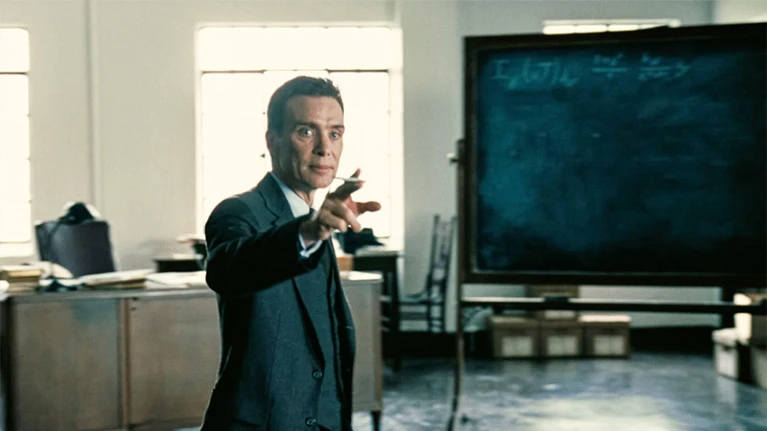
Cillian Murphy picked up the Best Actor award for his portrayal of Oppenheimer.

Credit: Landmark Media/Alamy

Oppenheimer won big at last night’s Oscars, scooping 7 awards out of 13 nominations, including best picture. The film has been lauded for its accurate portrayal of physicist J. Robert Oppenheimer’s life and its examination of both the human and scientific toll of the Manhattan Project, the research programme that developed the atomic bomb in the 1940s at Los Alamos in New Mexico.

To ensure the film was as accurate as possible, director Christopher Nolan turned to several science advisers for information on Oppenheimer and his life, and the project itself, which culminated in the Trinity Bomb nuclear test on 16 July 1945 and the subsequent bombing of Hiroshima and Nagasaki in Japan, bringing the Second World War to a close at immense human cost.

Nature spoke to three of those advisers for some behind-the-scenes insight into the film’s creation.

Robbert Dijkgraaf, a theoretical physicist and currently the Dutch minister for education, was the director of the Institute for Advanced Study in Princeton, New Jersey, from 2012 to 2022, a job Oppenheimer had also held, from 1947 to1966. 

Kip Thorne, a theoretical physicist at the California Institute of Technology in Pasadena, is a close friend of Nolan’s and had worked with him on a number of previous projects, including the depiction of the gargantuan black hole in the film Interstellar (2014). 

And David Saltzberg, a physicist at the University of California, Los Angeles, worked as a scientific consultant for other productions, such as The Big Bang Theory, before applying his expertise to Oppenheimer.

What was your involvement in Oppenheimer?

Dijkgraaf:

In 2021, Nolan wanted to come and visit, to see the place where Oppenheimer had lived and worked for almost 20 years. I also lived in that house and, for 10 years, worked in the same office that Oppenheimer once used. We had a long discussion about Oppenheimer, but also about physics, which I loved.

Thorne: 

I spoke with Cillian Murphy about his portrayal of Oppenheimer for the movie. I knew Oppenheimer when I was a graduate student at Princeton, from 1962 to 1965, and a postdoc from 1965 to 1966, so there was some discussion about Oppenheimer as a person.

Saltzberg: 

I was called in to help out with the production in scenes that were filmed in Los Angeles. I worked mostly with the prop manager. That involved things like deciding what was on the chalkboards, or what equations Oppenheimer handed to Einstein to show whether the atmosphere would catch fire.

Tell us about some of your interactions with the director and cast

Dijkgraaf:

Nolan visited Princeton twice to tour the premises. I remember we walked from the house to the institute. It’s this beautiful walk with nice trees. I remember telling him it’s the perfect commute, because Einstein and [Austrian physicist] Kurt Gödel always walked along that path. In the movie, Lewis Strauss meets Oppenheimer and he points out the house and says “it’s the perfect commute”. I thought, ‘wait a moment - this is a very familiar scene!’

I was struck that Nolan was really, really interested in what it means to be a physicist.

I also remember he really appreciated the pond at the institute. Quite a few of the scenes in the movie are shot near the pond - it’s a favourite place for many people there. It’s a place to think and contemplate.

Saltzberg:

I sometimes had to explain the physics of a line of dialogue to the actors, enough that they knew the emotional truth of the line and why they were saying it. There was one particular line in the script which was incredibly complicated, about off -diagonal matrix elements and quantum mechanics. Even when I read it I had trouble understanding exactly what it was saying. Cillian really wanted me to explain it to him. We got there, I think, but it was difficult.

A similar thing happened with Josh Hartnett, who played [American nuclear physicist] Ernest Lawrence. Every time he had a spare moment, he would come and talk to me about physics. It was uncanny because he was already in makeup and costume. I never met Lawrence, but I’ve seen plenty of pictures, and it was just eerie. He looked like Lawrence walking around the room.

What did you make of the science in the movie?

Saltzberg:

It was wonderfully accurate. It’s really amazing. Christopher Nolan clearly understood the science. There’s a scene in which Oppenheimer is writing on the chalkboard explaining that nuclear fission is impossible, when Lawrence walks in and says “well, [American physicist Luis Walter] Alvarez just did it next door”. So I had some equations put on the board that Oppenheimer might have had that proved fission is impossible. Most of the audience wouldn’t recognize that, but it made me feel good.

Dijkgraaf:

It was really well done. I loved that the movie consistently looks through the eyes of Oppenheimer. The physics discussions were very good — the right equations were on the blackboards! 

What was Oppenheimer like as a person?

Thorne: 

He was just a superb mentor, extremely effective. He had enormous breadth and an extremely quick mind. He had this amazing ability to grasp things very quickly and see connections, which was a major factor in his success as the leader of the atomic bomb project.

Dijkgraaf:

He was both a scientific leader and a government adviser. At that time, Einstein, who was quite crucial in starting up the atomic bomb project, really turned into a father of the peace movement. A character who wasn’t in the movie, [Hungarian-American mathematician] John von Neumann, wanted to bomb the Soviet Union, so he was completely on the opposite side. Oppenheimer was trying to walk the reasonable path between those two extremes, and he was punished for it. So I often feel his character generates these mixed feelings. It’s a fascinating example for anyone who wants to be a scientist and play a role in public debate.

Is it satisfying to see a science-based film get such recognition at the Oscars?

Thorne:

It’s wonderful it’s got this level of attention. It’s a film that has messages that are tremendously important for the era we’re in. Hopefully it raises the awareness of the danger of nuclear weapons and the History

Nuclear physics crucial issue of arms control.

Dijkgraaf: 

We often complain there’s no content in popular culture. For me, the biggest surprise was that this difficult movie about a difficult topic and a difficult man, shot in a difficult way, became a hit around the world. I feel that’s very encouraging. The hidden life of physicists has become a part of popular culture, and rightly so.

doi: https://doi.org/10.1038/d41586-024-00715-3

Wednesday, November 27, 2019

Watch How Roger Deakins Shot '1917' All In One Take

I think the use of long single takes in a movie are fantastic. The film '1917' directed by Sam Mendes uses this extensively. The film about WW1 will be released this Christmas. I haven't seen this film, so don't have an opinion about it, but the shots look amazing.

The cinematographer is the master of the art Roger Deakins.


Friday, May 10, 2019

Magic of Molecular Maya

The latest email newsletter from Clarafi has links to Scientific Visualisations using software including Molecular Maya.

Molecular Maya (mMaya)

"A free plugin for Autodesk Maya that lets users import, model and animate molecular structures. We leverage the power and flexibility of Maya while offering innovative, intuitive tools specialized for the challenges of molecular modelling and animation. mMaya is further enhanced by a series of 'kits' that expand its functionality and greatly streamline molecular modelling, animation, and simulation (see below)." (Clarafi)

System Requirements

  • Maya 2015-18 (note, 2018 is now supported)
  • OSX or Windows

Clarafi gives a list of many software tools that can be used for Scientific Visualisation. I think it is all rather fabulous.

Clarafi has a showcase of great examples of animations.

Here is an example of the animation "What is a Protein" from the Protein Data Bank. I think it is the best introduction to proteins I have ever come across.


The Protein Data Bank is a source of data in XML format to use with animation software.

My cloud software project has a couple of modules that work with the Protein Data Bank.

Here is a great animation of the growth of a chicken embryo.


The most stunning scientific animation of a cell I have ever watched is Inner Life of the Cell.

"The Inner Life of a Cell is an eight-minute animation created in NewTek LightWave 3D and Adobe After Effects for Harvard biology students",

"Created by XVIVO, a scientific animation company near Hartford, CT, the animation illustrates unseen molecular mechanisms and the ones they trigger, specifically how white blood cells sense and respond to their surroundings and external stimuli."

Sunday, May 5, 2019

Toy Soldiers - Behind the Scenes at Stan Winston

"Go behind the scenes of Joe Dante’s Small Soldiers and see how Stan Winston Studio used real puppets and on-set performance to bring to life the militarized Action Figures."

From April 30, 2019, blog post at Stan Winston School of Character Arts (SWSCA).

The Studio took on this job soon after the magic of the Jurassic Park and Terminator jobs.


These are a few of the photos from the SWSCA blog which are taken from the truly excellent book The Winston Effect: The Art & History of Stan Winston Studio. It must have been a lot of fun.

Thursday, April 11, 2019

The NAB Show 2019

From Wikipedia

"NAB Show is an annual trade show produced by the National Association of Broadcasters. It takes place in April, and has been held since 1991 at the Las Vegas Convention Center in Las Vegas, Nevada. The show's tagline is "Where Content Comes to Life". NAB show is the largest show for media, entertainment and technology. The NAB shows covers: broadcast TV, radio, production, post production, news gathering, streaming, cable TV, satellite TV, film restoration, data storage, data management, weather forecasting, industrial TV, FX, CGI, connected media, cybersecurity and more. NAB had 103,000 attendees from 161 countries and more than 1,806 exhibitors in 2016. There are also exhibitors in Las Vegas hotels not counted in the official convention center displays. In addition to the exhibitors' booths, there are lectures, panel discussions and workshops. In 2017, there will be over 200 of these sessions..."

From No Film School

A playlist of coverage from NAB 2019. Worth watching.


NAB Show has live streams and recorded video coverage as do many of the product manufactures.

A bit of a toy fest. I like looking at the lighting, lenses, digital cameras and gripping gear.

I do have my heart set on Arri Alexa - just saying. And I would like to get to NAB.

Friday, April 5, 2019

Gelatin Moulds

Gelatin was used during the Victorian era to make moulds used in casting plaster sculptures.

Since then various artists and model makers have come up with ways to improve this by adding Glycerine.

The resulting Gelatin/Glycerine mixture (without water) is gently melted and poured around a "master" shape to create a reusable flexible mould. The mould can later be melted down and reused many times.

I have also come across a miniature model makers recipe that added Sorbitol to the Gelatine Glycerine mix in equal 1/3 portions. However, non-food grade Sorbitol powder is impossible to obtain in NZ in bulk. It does come with 50% water added for use in the Dairy Industry in milking sheds. $600 for 200L which then has to be processed to remove the unwanted water.

So a Gelatine Glycerine mix looks to be the way to go.

Here are some links to recipes and articles


And a 2 part video...


Thursday, April 4, 2019

Art Direction Training at Pinewood Studios

Terry Ackland-Snow runs a special school based at Pinewood Studios in the UK.
It looks quite magical. and worth every penny to pay to go on these 2 courses.

As Terry explains ...

Film Design International (FDI) is an Art Direction training provider, which offers essential, industry-relevant courses for anyone who wants to work in the Film and TV art departments.

Ideally located at the internationally renowned, Pinewood Studios; both the Art Direction Course promise the student a total immersion in the film and television world, and a vitally important first step towards becoming a successful Art Director and Production Designer

We currently provide two training courses and you can find out more detail about each of them via our Courses page.

FDI was set up at Pinewood Film Studios in 2001 by Terry Ackland-Snow, to offer draughtsmanship courses for the film and television industry.

The courses are taught personally by Terry along with other professionals, so students benefit from the vast knowledge, insight, skills and techniques that he has acquired throughout his illustrious career which spans 50 years in the industry. Starting as a Junior Draughtsman in 1960, he worked on more than 80 film and television productions making his way up to being appointed as a Supervising Art Director and Production Designer. IMDB link.

Terry along with the team members are passionate about the industry that he has devoted his career to. The courses are intensely practical and designed to give comprehensive knowledge of film techniques to be used on the drawing board.


A happy hard-working student has a blog of her journey at the school.


Tuesday, April 2, 2019

Into the Breech

As many close friends know, I have been quietly researching a number of dramatic film and documentary projects for some time now.

I'm now confident enough to start to move these projects to the predevelopment stage.

But to do this, I need a hell of a lot of funds to rent space, pay for great scriptwriters, researchers and designers etc.

And I want to have a top-notch crew, rather than rely on favours.

Also, I would rather risk my own money than someone else's.

And have minimal dealings with the film and TV industry suits who suck in my opinion and have no taste.

To this end, I'm taking a detour and returning to software development after an absence of 10 years. Previously I led a team for 10 years on a private cloud computing platform for conservation in NZ. It was technically successful but not financially. Mainly because it was 20 years ahead of its time. It was just too early and I got some things wrong.

But as it turned out, it was an invaluable learning opportunity for me. So I was very lucky and got some hard-won experience.

Cloud computing has come along way since that time and a lot has been learned across the industry.

Recently out of sheer frustration with available software, I have had to build my own applications to support my own private projects.

Then the penny dropped ...

Other people might need the same tools and maybe they would pay for that service.

I'm now developing a scientific cloud platform to be commercialised. After 18 months, it is at a crude working prototype stage which I'm very happy with. The next stage will be very very hard.

My intention is that this will be a fundraiser for my film projects.

You can follow this project on a separate technical web site aimed at developers.

In the meanwhile, Redworks is my happy place and I'll be still pottering around in my art studio from time to time and posting away on www.redworks.co.nz.